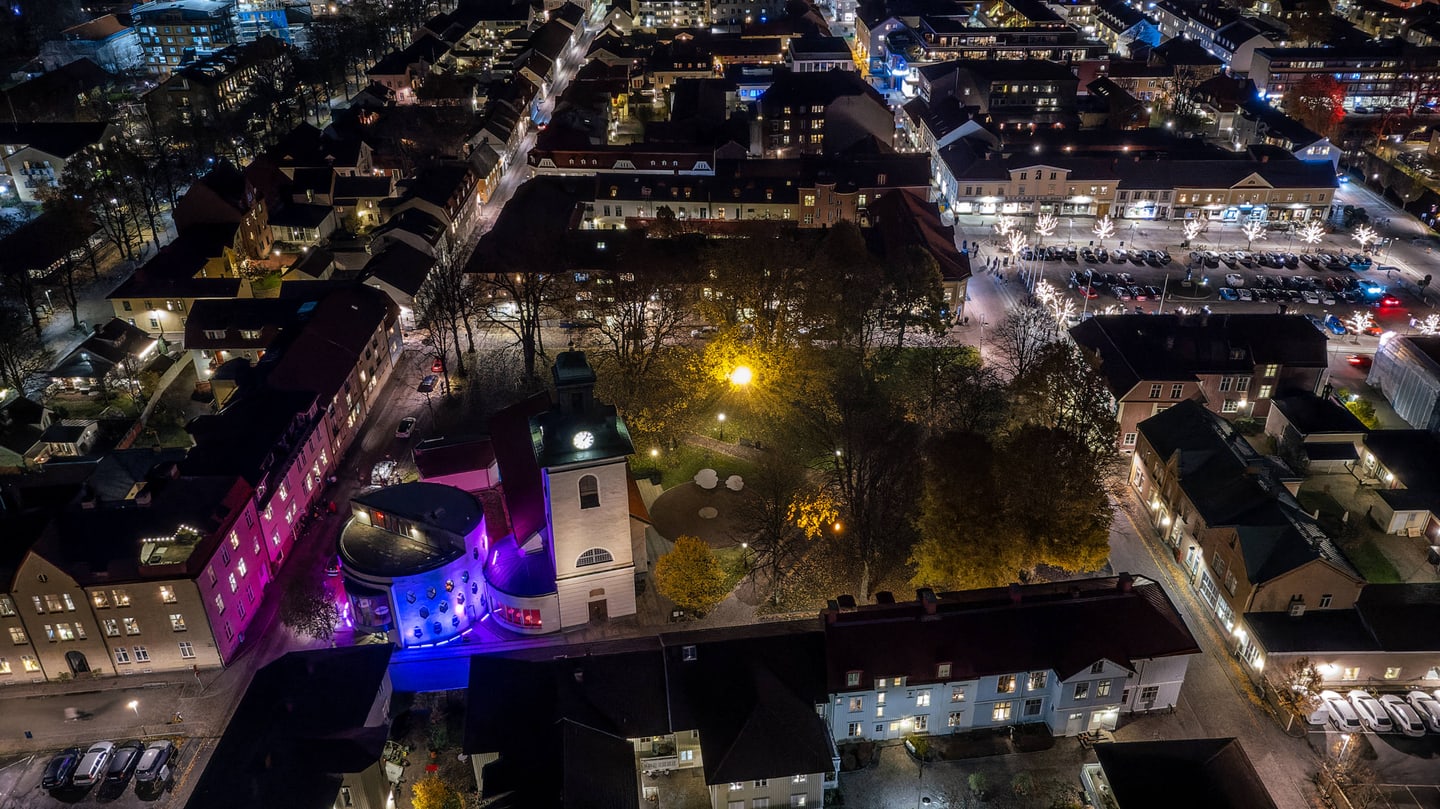
I'm not a fan of this picture to be honest. It's too dull. What I've come to appreciate is the level of detail I managed to get out of it. The camera is the size of a large peanut and it's strapped to a flying object, at night, in typical Swedish October weather. Let me explain (to the best of my limited ability):
You see, to get a picture you need to expose your sensor to light. The size of the sensor (or lens or whatever, some camera-thingy) is proportional to the amount of light it captures. Basically, a bigger camera is capable of letting in more light for any given time. The longer the shutter (or whatever) is open, the more light gets captured. This is exposure time. However, any movement of either camera or subject during this time will result in a picture that is smeared, out of focus, or ruined in some way.
This shot was taken at night with small, intensive light sources. The difference between light and dark here, the contrast, is absolutely huge. To get anything out of the shadows, you need to capture lots of light, i.e., a long exposure time (and/or a high ISO, whatever that is). This will easily overexpose any bright parts of the image though, making them too bright. The lamp in the middle of the picture is a good example. Not only will you have trouble capturing a sharp image because of the long exposure, the camera just isn't capable of handling the huge difference in brightness.
This is where exposure bracketing (right?) comes in. Or HDR. Or whatever. Basically you take multiple pictures with different settings, capturing different amounts of light and detail, add them all together, and vóila. The resulting image can be averaged into the dullness above, raising the dark parts and lowering the light parts. HDR, High dynamic Range, is basically really dark darkness and really bright brightness. My display isn't capable of displaying proper HDR so it's obviously more difficult to produce. Ensuring that you, the viewer, sees the same thing I do, as the creator, is even more difficult. We might explore this further in a future rant.
In any case, splicing 3 images together raises an issue similar to that of a long exposure. If the images aren't perfectly aligned, the output gets fuzzy and all messed up. People are alive and thus move, so that's a problem. We are also flying, so duuuuh. Considering weather conditions in Sweden at this time of year... Yeah. DuckDuckGo "jet stream" and you get the point. This is luck, not skill.
All in all, I'm coming around. I still don't like this picture, but I suppose I respect it. On the other hand, I'm probably just rationalizing. The amount of time I spent on this makes me think of the sunk-cost fallacy, one of my favorite cognitive biases. Anyway, enjoy.


